Research
My research focuses on computational detonation, with an emphasis on the following areas:
(Detonation physics)
- Three-dimensional effects
- Rotating detonation waves
- Shock-bubble interaction
- Re-initiation after diffraction
- Vibrationally non-equilibrium
(Scientific computing)
- High-performance computing
- Adaptive mesh refinement
- Numerical methods
(Other)
- Micro flapping vehicles
- Particle image velocimetry
Publications
This list includes formally published journal articles, the authored book, and conference proceedings. Preprints and individual chapters from the CESE book are omitted. See also my Google Scholar profile.
Journal articles
- Xinke Shao, Qingyang Meng, Ken Chun Kit Uy, E Fan, Lisong Shi, and Chih-Yung Wen (2026). Influence of reactant spatial heterogeneity on propagation and performance of hydrogen-fueled rotating detonation waves. International Journal of Hydrogen Energy, 241, 155590.
- Lisong Shi, E Fan, and Chih-Yung Wen (2026). Two-dimensional numerical simulation of imploding detonations. Shock Waves, 36, Article 2.
- Jiaxin Yao, Weikang Liu, Guochun Li, Deyu Kong, Xiaodong Chen, Lisong Shi, and Xuxu Sun (2026). Detonation diffraction and re-initiation in hydrogen–oxygen mixture with concentration gradients. Combustion and Flame, 286, 114874.
- Xinke Shao, Lisong Shi, Ziqi Jiang, Zijian Zhang, Honghui Teng, and Chih-Yung Wen (2026). Stabilized detonation triggered by a single ignition kernel in hypersonic ramp flow. Proceedings of the Combustion Institute, 42, 106005.
- Xincheng Wang, Yong Zhang, Jijian Meng, Yaming Zhang, Zhen Li, Cheng Liu, Chen Huang, and Lisong Shi (2025). Investigation on the combustion and explosion characteristics of lithium iron phosphate battery thermal runaway gas: Effects of initial pressure and ignition energy. Fuel, 399, 135605.
- Deyu Kong, Xinyu Zhang, Jiaxin Yao, Weikang Liu, Xuxu Sun, Xiaodong Chen, Lisong Shi, Jinhua Wang, and Zhijun Xu (2025). Experimental study on the detonation characteristics in ammonia-hydrogen-air mixtures. Process Safety and Environmental Protection, 107641.
- Xinke Shao, Zijian Zhang, Lisong Shi, Jiaao Hao, and Chih-Yung Wen (2025). Effects of incoming boundary layer on the initiation characteristics of oblique detonation waves over a compression corner. Combustion and Flame, 282, 114539.
- Ziqi Jiang, Zongnan Chen, Lisong Shi, Zijian Zhang, Jiaao Hao, and Chih-Yung Wen (2025). Numerical study of oblique detonation initiation assisted by local energy deposition. Aerospace Science and Technology, 111278.
- Lisong Shi, Chih-Yung Wen, Xuxu Sun, and E Fan (2025). Detonation propagation in continuously curved three-dimensional ducts. Combustion and Flame, 280, 114363.
- Lisong Shi, Chaoxiong Zhang, and Chih-Yung Wen (2025). Adaptive mesh refinement algorithm for CESE schemes on unstructured quadrilateral meshes. Computer Physics Communications, 311, 109565.
- Weikang Liu, Xuxu Sun, Jiaxin Yao, Deyu Kong, Xiaodong Chen, and Lisong Shi (2025). The failure and re-initiation of quasi-detonations in stoichiometric acetylene-oxygen mixtures diluted by nitrogen. Fuel, 380, 133125.
- Lisong Shi, Zijian Zhang, E Fan, and Chih-Yung Wen (2025). Simulations of detonation wave reflection over cylindrical convex surfaces with a detailed reaction model. Physics of Fluids, 37(8).
- E Fan, Tianhan Zhang, Jiaao Hao, Chih-Yung Wen, and Lisong Shi (2025). Fire: An open-source adaptive mesh refinement solver for supersonic reacting flows. Computer Physics Communications, 109881.
- Xinke Shao, Zijian Zhang, Lisong Shi, Hanli Huang, and Chih-Yung Wen (2024). Effects of swirling inflow on the stability and combustion mode of rotating detonations. Physics of Fluids, 36(2).
- Yazhong Jiang, Lisong Shi, and Chih-Yung Wen (2024). Analysis and applications of the upwind conservation element and solution element scheme for compressible flow simulations. Physics of Fluids, 36(12).
- Lisong Shi, E Fan, Hua Shen, Chih-Yung Wen, Shiman Shang, and Hongbo Hu (2023). Numerical study of the effects of injection conditions on rotating detonation engine propulsive performance. Aerospace, 10(10), 879.
- E Fan, Jiaao Hao, Ben Guan, Chih-Yung Wen, and Lisong Shi (2022). Numerical investigation on reacting shock-bubble interaction at a low Mach limit. Combustion and Flame, 241, 112085.
- Lisong Shi, Ken Chun Kit Uy, and Chih-Yung Wen (2020). The re-initiation mechanism of detonation diffraction in a weakly unstable gaseous mixture. Journal of Fluid Mechanics, 895, A24.
- Ken Chun Kit Uy, Lisong Shi, Jiaao Hao, and Chih-Yung Wen (2020). Linear stability analysis of one-dimensional detonation coupled with vibrational relaxation. Physics of Fluids, 32(12).
- Ken Chun Kit Uy, Lisong Shi, and Chih-Yung Wen (2020). Numerical analysis of the vibration-chemistry coupling effect on one-dimensional detonation stability. Aerospace Science and Technology, 107, 106327.
- Ken Chun Kit Uy, Lisong Shi, and Chih-Yung Wen (2019). Prediction of half reaction length for H2/O2/Ar detonation with an extended vibrational nonequilibrium Zel'dovich–von Neumann–Döring model. International Journal of Hydrogen Energy, 44(14), 7667–7674.
- Ken Chun Kit Uy, Lisong Shi, and Chih-Yung Wen (2018). Chemical reaction mechanism related vibrational nonequilibrium effect on the Zel'dovich–von Neumann–Döring detonation model. Combustion and Flame, 196, 174–181.
- Lisong Shi, Hua Shen, Peng Zhang, Deliang Zhang, and Chih-Yung Wen (2017). Assessment of vibrational non-equilibrium effect on detonation cell size. Combustion Science and Technology, 189(5), 841–853.
- Lisong Shi, Ken Chun Kit Uy, Sing Kiong Huang, Zhiyong Yang, G. P. Gary Huang, and Chih-Yung Wen (2016). Experimental investigation on flow characteristics of a four-wing micro air vehicle. International Journal of Micro Air Vehicles, 8(3), 181–193.
Book
- Chih-Yung Wen, Yazhong Jiang, and Lisong Shi (2023). Space–Time Conservation Element and Solution Element Method: Advances and Applications in Engineering Sciences. Springer Nature, Engineering Applications of Computational Methods, Volume 13.
Conference proceedings
- Lisong Shi and Chih-Yung Wen (2025). Numerical simulations of imploding detonations. 30th International Colloquium on the Dynamics of Explosions and Reactive Systems.
- Lisong Shi, Peng Zhang, Chih-Yung Wen, Hua Shen, Matteo Parsani, and Deliang Zhang (2019). Numerical study of hydrogen–air detonation in vibrational non-equilibrium. 31st International Symposium on Shock Waves 2: Applications, 157–163.
- Ken Chun Kit Uy, Lisong Shi, and Chih-Yung Wen (2017). Investigation on vibrational nonequilibrium effect on ZND detonation model. International Symposium on Shock Waves, 293–299.
Featured open-access papers
Influence of reactant spatial heterogeneity on propagation and performance of hydrogen-fueled rotating detonation waves
Xinke Shao, Qingyang Meng, Ken Chun Kit Uy, E Fan, Lisong Shi, and Chih-Yung Wen.
International Journal of Hydrogen Energy, 241 (2026), 155590.
View paper in a new tab · Publisher page · CC BY 4.0
Preview paper on this page
Two-dimensional numerical simulation of imploding detonations
Lisong Shi, E Fan, and Chih-Yung Wen.
Shock Waves, 36 (2026), Article 2.
View paper in a new tab · Publisher page · CC BY 4.0
Preview paper on this page
The papers above are reproduced unchanged under the Creative Commons Attribution 4.0 International License. Copyright remains with the authors.
Gallery
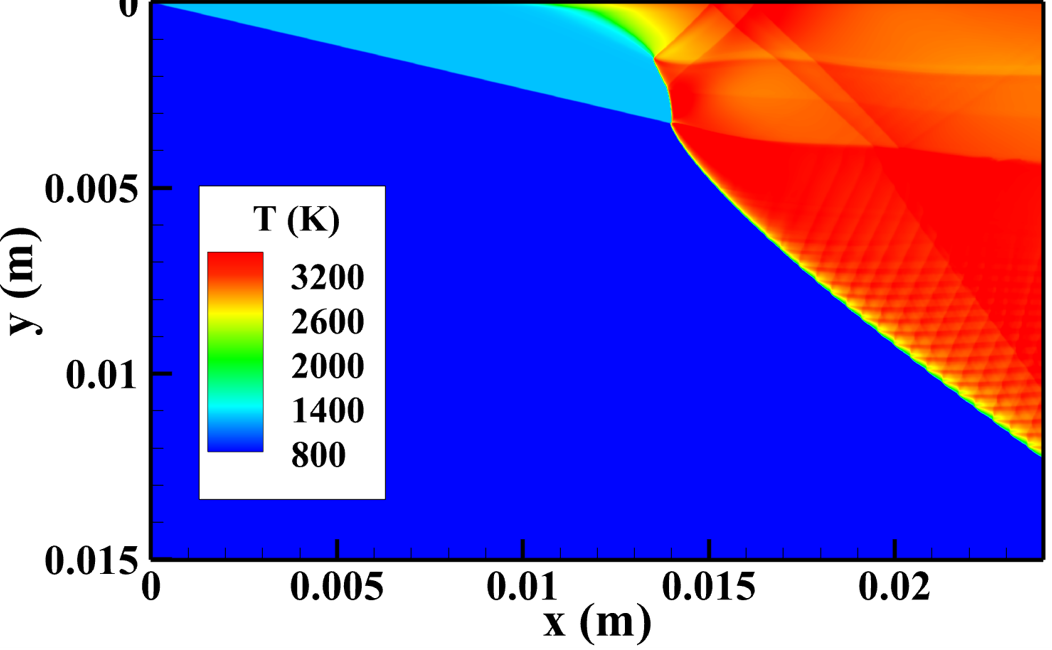
Oblique detonation wave: computed by in-house code UCESE3D
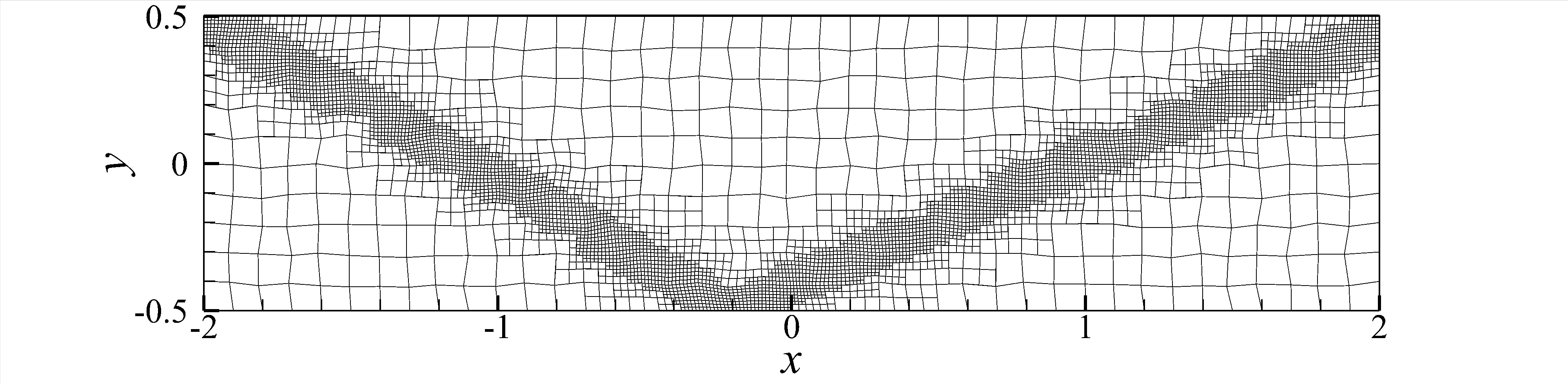
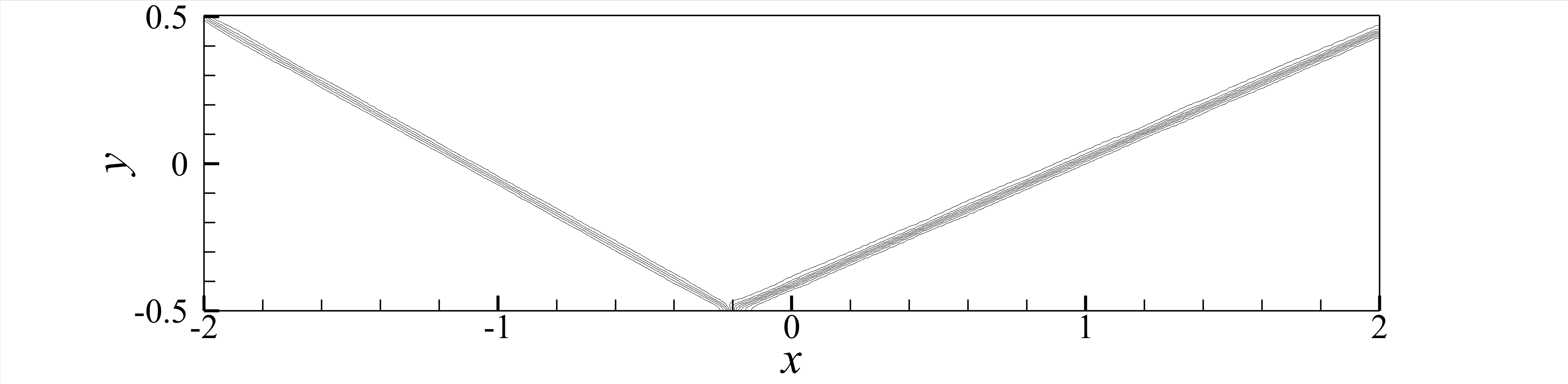
Adaptive mesh refinement: computed by in-house code QAMR-SES, mesh distributions & density contour
published, open access, https://doi.org/10.1016/j.cpc.2025.109565
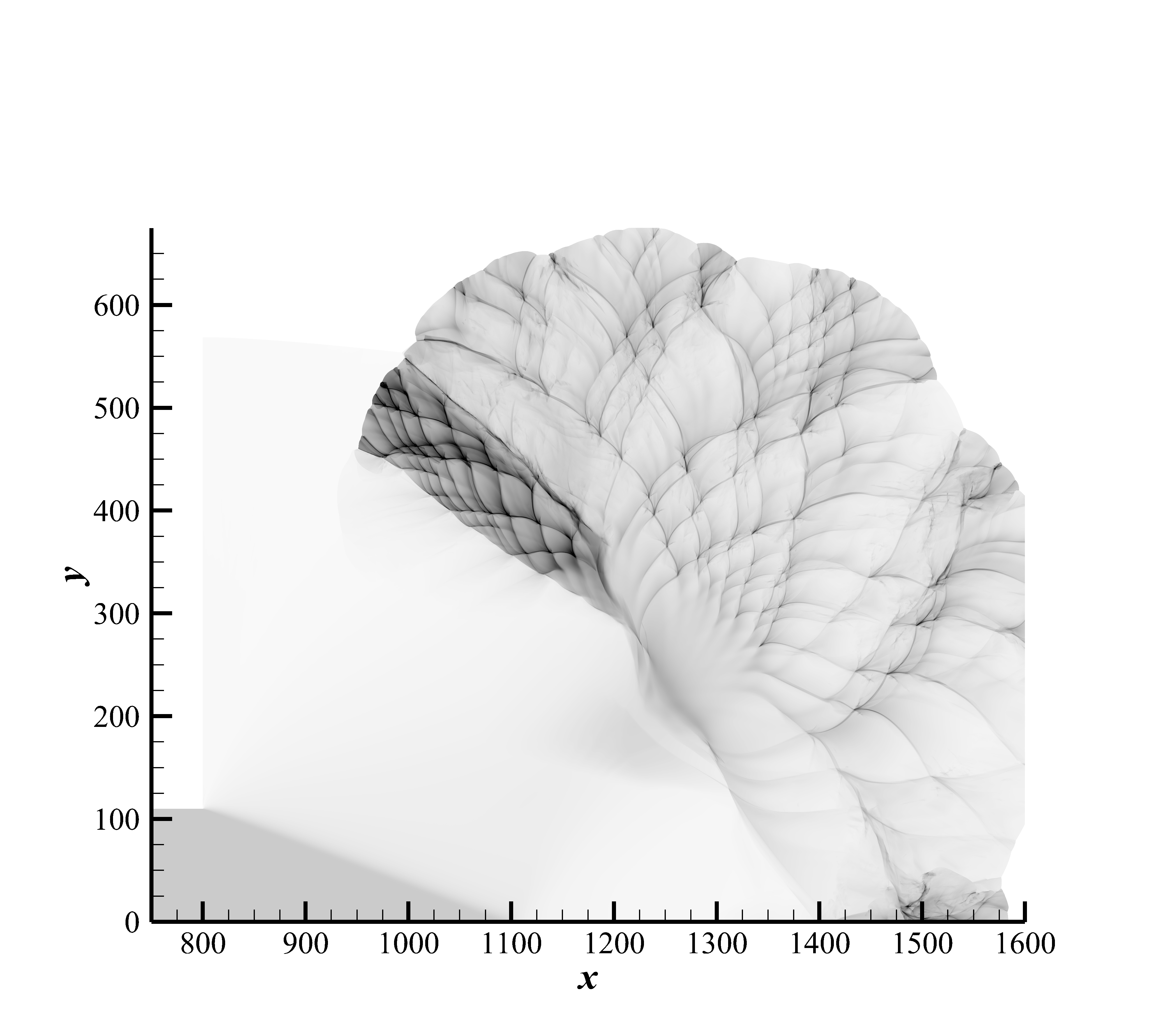
Detonation diffraction: computed by in-house code UCESE3D, planar supercritical case
published, https://doi.org/10.1017/jfm.2020.311
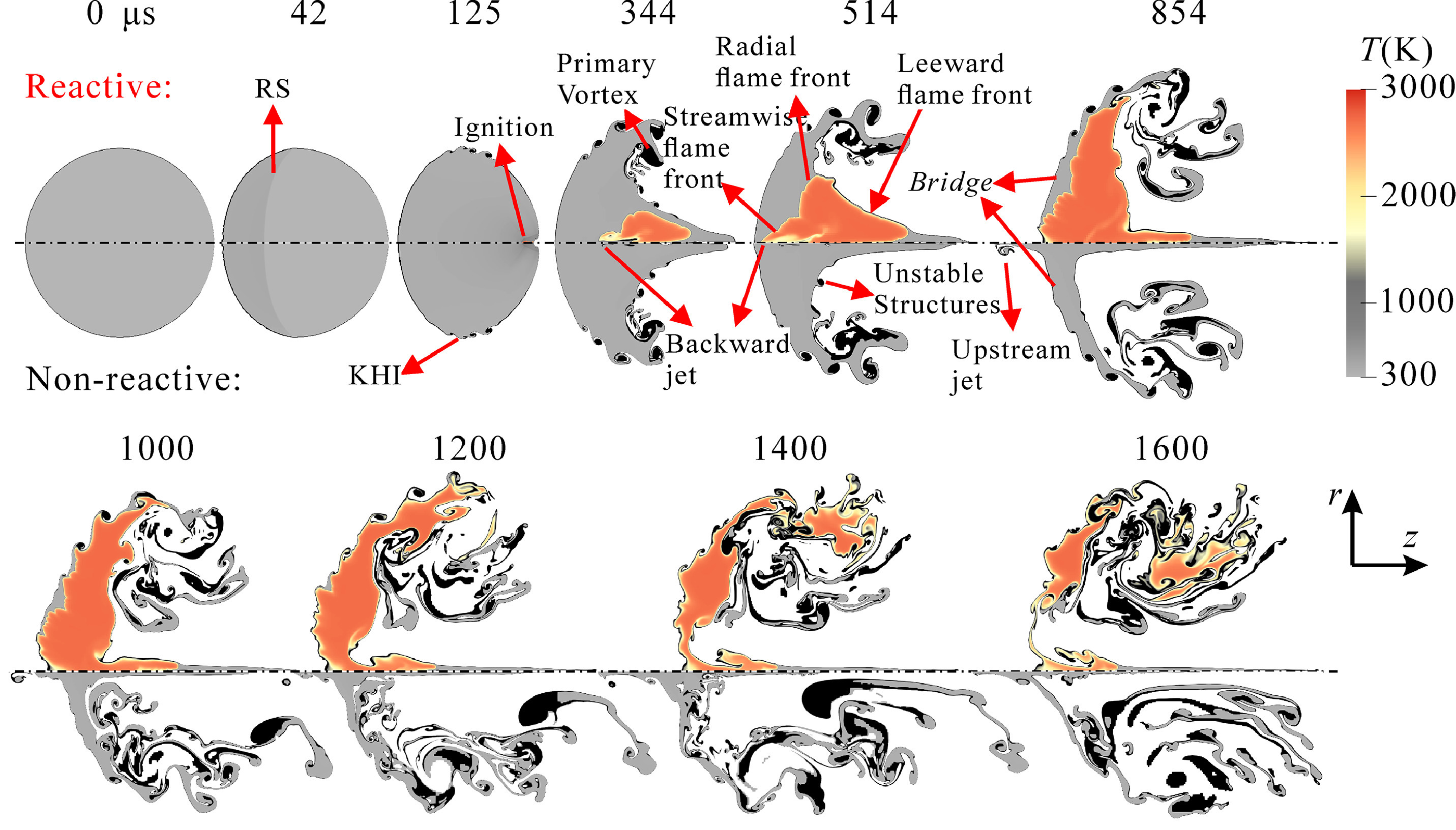
Reactive shock bubble interaction: computed by in-house code FIRE developed on the framework ECOGEN
published, https://doi.org/10.1016/j.combustflame.2022.112085